
3/16/09

Ungodly Symbols: Notes on "Zodiac"

A slow pace down the streets of suburban America, fireworks ablaze in the night sky, folks on the pavement feeling the atmosphere (and each other), all from the vantage point of a vehicle, and you know something's going to go wrong. The fully-demarcated beams of light cutting through the darkened fog from the mug of the same car now at lovers' lane says it is so. And it is true, but it's a rarity among cliches to rear its head in David Fincher's "Zodiac" which successfully averts most truisms of the serial killer genre to become a fine and handsome exploration of how the mythos of a monster escapes his own grasp and becomes the fare of the populace. This is the stuff of legends.

Sgt. Mulanax (Elias Koteas), Inspector Armstrong (Anthony Edwards) and Inspector Toschi (Mark Ruffalo) question eventual suspect Arthur Leigh Allen (John Caroll Lynch).

The plot of the film, though titled "Zodiac" after the killer who terrorized Northern California from the late-1960s to the mid-70s, is not about the man but his opponents, told in disjointed segments which fade to black every couple of minutes (and as short as two) to draw out a sort of detached view of the repercussions that begin to swirl. The framing device is almost episodic, each piece devoted to one setting and only a few of the handful of characters that come to dominate our perspective on the investigations, and unsheathing just one revelation, normally, in a fashion that's still more economical in filling in the details than most in the serial killer archive. The film's running time is insignificant in its ability to conjure up a dense portrait of the people and places economically, to stitch them together to form a dynamic, and totally alive, entity. (I loved the references to the kids on Haight Street and on Castro, to "Dirty Harry" and Steve McQueen, to the Altamont concert by the Rolling Stones on the radio, and to the construction of the Transamerica building set against time and bad weather.) It is a city fascinated as it is frightened at the prospects of the killer's next unavoidable move. And while disjointed, the picture's still cohesive, progressive, each short segment offering ample visual flourishes to build a layered perspective of the lives that, ultimately, were built around these - let's face it - surprisingly few deaths. Letters, television screens, radio broadcasts, files, photographs. One stitch of shots showed Inspectors Toschi (Mark Ruffalo) and Armstrong (Anthony Edwards) in the safety of the police department, but entrenched in materials all related to the Zodiac killer: they can't escape him, he's seeped into every nook.

The segments become like the symbols etched in ink on the ciphers themselves in that they are bounded in time as the symbols are in space - allowing for fluid transitions to sometimes many years later - and they signify little when isolated. But taken together, as not a sentence but a three-dimensional agglomeration of history and reality, and theme for the sake of the movie, it chronicles just about every facet of the people in question, so that we may feel in our examination the horrific weight of a dead body, the terror of looking evil straight in the face, treading in a sea of his dark materials.

It's amazing what Fincher is able to achieve in his visual and thematic reaches by using three (four if Armstrong is included) central characters as opposed to just one, and his inclinations towards generousness are sparse, so the decision is all the more atypical of him. Fincher's own "Se7en" explored similar territory using a fictional serial killer who equipped a biblical motif to peddle his self-righteousness. But where that film used Brad Pitt to explore the pressures of a world in moralistic transition, with Kevin Spacey as both prophet and executioner of that movement in John Doe - a nod to the everyman at the heart of many a Philip Roth novel who's caught in a perpetual struggle with nihilism and the atrophying of his traditional morals - "Zodiac" invests in its heroes, and splices the themes of truth and accountability across its multiple characters to show its multitude of colors (its cleansing powers vested in Jake Gyllenhaal's Robert Graysmith, its value as a commodity for Robert Downey, Jr.'s Paul Avery, and the desperation for justice and balance in the endlessly book-abiding inspectors Toschi and Armstrong). Each somehow pays the price for betting in on the game to find the killer's identity, be it through family deterioration, career loss, psychological turmoil, the forfeiting of years from life.

Paul Avery (Robert Downey, Jr.), the San Francisco Chronicle journalist, pre-alcoholism

The lack of a prevailing point of view on the side of the protagonists with instead a set of them beckons to Fritz Lang's "M," showing us society's dance to flood all of the communication systems and caution the public about the evildoer's presence, although "Zodiac" does this within the institutions of media and police enforcement while "M" lodges itself at society's grassroots and the underworld below it. This dance - a veritable game of telephone - in which no one knows entirely the same things as everyone else, and no one knows exactly what's true at all, is practically the preliminary steps to the development of the urban legend. It is a choreography of gesture, word-of-mouth and broadcasts. But while "M" ends up empowering its serial killer by buckling itself to his perspective throughout his pursuit and in the subsequent trials which end in his persecution (and nearly execution), "Zodiac" obstructs any such attempt, keeping the killer an exaggerated version of himself. It becomes appropriate that a cartoonist, likely influenced by the aesthetics of the comics, would make the attempts at demystifying him both in illustration and in investigation, reaching the best conception on both terms.

The tenets of the urban legend, I think, elucidate a rather strange scene at the two-third mark of the film where Graysmith (Gyllenhaal) follows a tipster back to his home, ultimately making their way into a very unhealthily-lit basement. Why was the theater operator framed in that way, dampened by rain and drenched in shadow, in one of those basements that's a rarity in California, staring down the Boy Scout hero, noises opening up out of the walls and ceilings like a chest filled with monsters? Was someone there? Was it intended only as the requisite scare-scene that's a staple in serial killer movies where a character finds it is their lack of keen insight or awareness that has finally doomed them? Fincher's parody of such stock sequences? It would have to be more than simply Graysmith's elevating levels of paranoia as he further invests in the case, engrossing himself in demonic details of death and deviance, because Fincher's perspectival approach has up to this point and ensuing thereafter been detached, impartial, without predisposition (no, it only gives you enough reason to think it was Arthur Leigh Allen by film's end, it doesn't make the verdict for you). It would be inconsistent in a myriad of consistency, of strict restraint and immaculate discipline, for this to be so. The old man, then, must be parodying the specter of the killer, no doubt keyed to the opportunity with Graysmith so obviously expressing his distress, a perfect moment to release all of the tensions that come with having lived in the same city and possibly worked in the same theater as the looming killer. You are not the killer, but you and the killer share a basement and writing styles. It's too easy. The lingering shot of the man as he stares down the boy, fingers fondling the light switch as he draws it down, is comical compared to the rest of the film's tone, intense only because it resembles our childhood memories of Scooby-Doo.

The Zodiac's third couple: Bryan Hartnell (Patrick Scott Lewis) and Cecilia Shepard (Pell James) at Lake Berryessa in Napa County

There is also a brief scene in which Robert Graysmith confronts Arthur Leigh Allen (John Caroll Lynch) for the first time in a hardware store after having courted the actual evidence through his acquaintanceship with the more experienced, and more self-obsessed, Paul Avery - and make no mistake, their short partnership was no fusion of friendship, it was a partnership only founded on the grounds of their common drive - and after having taken on the mantle himself, and romanced the idea of his being able to identify the killer after Avery's descent into drunkeness. It is rather short, simple, but wracked in tension, the antithesis of a release - it raises the stakes in fact, the chess pieces assembling within their minds (if you do believe Allen's the killer, which could go either way given the manner it's so masterfully wrought in ambiguity). A friend of mine told me that he found the scene particularly hokey, like one of those payoffs where the hero needs not accomplish any real thing, he's satisfied conceding defeat because he's learned a lot and knows he'll always keep the receipts of victory in his heart. But this isn't victory, this is a vendetta, and his confrontation is not about holding the real truth in his heart, it is about laxing his self-destructing obsession with a man he knows nothing about. ("We know he reads the Chronicle," is what Graysmith's wife tells him, the only truth they ever attained.) He isn't conceding defeat, he is actively preventing his own implosion, something Inspector Toschi failed to do and what Paul Avery did too early given his talents (but in spite of his narcissism). Graysmith's ending severance is our realization that the deeds of some men can never be figured out because of our nature to imbue them with more power than they deserve (and if Zodiac was talented at anything, it wasn't killing, it was self-publicity), and that our derivation of reality is often composed of too many layers of bullshit. Reality, the world, is simply a harsh place, so let the youths sort it all out.


IMAGES from: Livejournal

3/15/09

We Are Critics

If you know me well enough and have spoken with me at any point in the last year, you'd know that I've been laboring intensely over an undergraduate thesis - a rather long ethnography - which I hope becomes the subject and foundation for my visual anthropology graduate work to be continued at USC. It's about film critics and their ongoing predicament of job losses, the seeming decline in relevance in the public, and the surge of competition being contended with in the arena of the internet. (It's a dilemma that I share some part of too as my goal is to write criticism either primarily or peripherally to some other job.) I'm specifically exploring the role of the internet in the community of critics and their popular consumption, and how the rapid succession of technological changes - from the advent of the Blackberry and mobile to YouTube to the review aggregates to the blog phenomenon to Twitter and so on - has either produced or might be impacting this dilemma. Most of the work has been chronicled in chapters of my monitoring of the industry over the last many months, expressed in some of these paradigm-shifting events, coupled with my familiarity with criticism and film journalism after several years of personal obsession. When it's finished, I will try to get it hosted someplace and provide a link so you all can read it and get your "nutritional" food-for-thought (as Jeff Wells might say) on the matter if you're not quite well-versed. Or you can validate/invalidate my two cents. It's become pretty comprehensive: a heavy dose of historical and theoretical discussion for context, life history and ethnographic portraiture (Kael, Sarris, Agee, Farber, Haskell, Bazin, etc.), sociological statistics, and of course some anthropological writings (Bourdieu for talk of taste, Foucault for some aspects on articulation and authorship, Hall for power structures). I hope it becomes a staple on the shelves of critics, critic-lovers and cinephiles as it's most definitely a tome of good faith and of pure love for the art of criticism. The cinema has already had its lovers strewn across celluloid in documentary-form, now it's time for the great commentators to get their dues.

So how nice for me to see that I might have yet another source to extract some tasty morsels of information in quotation and some further historical data in the SXSW-debuting "For the Love of Movies: A History of American Film Criticism." Witten and directed by Gerald Peary, produced by Amy Geller, and narrated by Patricia Clarkson (ever the literate thespian), it is a project that has been in development for years - not unlike my own - and takes on the gargantuan task of the issue which, as any historian or storyteller might tell you, opens up into a much larger dialogue. Jeff Wells puts it:

"It's a hell of a subject -- a chronicle of magnificent obsessions and magnificent dreams, and a rise-and-fall story covering scores of critics, the entirety of the Hollywood film culture from the '20s to the present, and hundreds if not thousands of movies."
The documentary assembles a wonderful set of critics both big and small to discuss their positionality in the industry and the spectrum of criticism. So wonderful are they I may not have to interview folks like I thought I might. (But if you'd like to make a contribution to my scholarly examination of the industry, then please let me know. I'd love to still get some good direct sources in.) Being a film, though, and subject to time constraints (this isn't PBS, after all) the film doesn't look to give you a piece-by-piece dissection of the business or its constituents, but it does "agreeabl[y] canoe ride down memory creek" and "with a tinge of melancholy" as Wells says, serving up the task more than sufficiently and with enough provocation and neutrality to stimulate spirited discussion. Discussion about what the critics now mean to us as targets of an endless flurry of infinitely variegated movies. The trailer (which is rather short, and sparse of the prevailing issues) is below:


Do you read anything by the critics anymore?


IMAGE from: Listal
IMAGES from: The NY Times
SCOOPED first by: Cinematical

3/14/09

Vote for this "High School President"

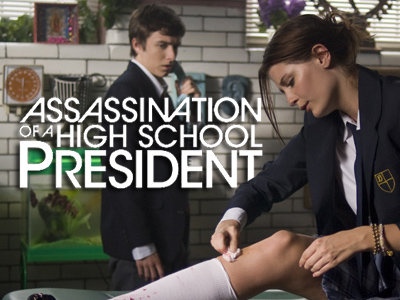
It's always a disappointment - for director, stars and potential audience - when a movie comes to any one of the festivals and fails to deliver, because it makes the film all the likelier to succumb to a fate at the hands of a tainted reputation ("Blindness" is a movie that debuted at Cannes in 2008 that never recovered from poor reviews), or to eternal obscurity as the filmmakers retreat to add and chop details which threaten its original integrity ("2046" is a case where drastic alterations post-Cannes aided its later reception). So it's even more tragic when a film, like "Assassination of a High School President" an arrival at Sundance in '08, comes to attract loads of high praise but then falls under stresses outside of its powers that can impede or altogether prevent its distribution. The Brett Simon-helmed comedy/noir which is equal parts murder mystery, a la Rian Johnson's "Brick" from 2005, and John Hughes-style high school comedy was furnished to Sundance last year by the Yari Film Group. It quickly attracted buzz for its irreverent and smart plot and "colorful, sexy characters," but because of recent events of Yari being forced into bankruptcy, the film is now threatened with being passed over for theatrical distribution and sent direct to DVD release, thereby relegating it to some dark, dusty corner of the local video rental store to be seen only by adventurous passers-by.

Even though the company is still able to operate and produce pictures, it was their releasing unit that filed Chapter 11, so this remains among several other pictures waiting to see an actual audience actually see it (say that five times fast). If "Brick," a hardboiled neo-noir with spit-fire dialogue and a relatively unknown cast, can make it and find its fanbase, then I see no reason why this film can't. "Brick" boasted Joseph Gordon-Levitt as its headliner who has emerged as an immensely talented young actor, but he's not quite as popular as, say, Mischa Barton ("The OC"), so I'm sure with the proper marketing of the involved talent and material, not to mention the great reviews it's already been getting throughout the blogosphere, I think this could become a rather successful niche film. I must also mention that Bruce Willis is in it as well, so there's an entirely other reason to commit the dollars. Being a tremendous fan of "Brick" myself, and a lover of noir in all its incantations, I relish any opportunity to see what kinds of twists can be applied to the genre, which suffers from general assumptions about its look, pacing and tone. (Jules Dassin's "Night and the City" was one of the films I watched in my earliest film classes which made me stop wanting to produce movies, and just write about their enchanting effect.)

Sony possesses the home video distribution rights and feels it best to just send it direct to DVD, but other studios are still waiting around and testing the waters to see if anything bites. In this economy, you can't really blame them. The film has an official Facebook page, so if it becomes known that there is a comparable audience for the film, it could be enough for a company (or Sony itself) to take the step up and write up the checks for the theatrical rights, press and adverts, and for distribution. As "Slumdog Millionaire" has shown, it's not always a longshot for an independent film to maneuver around its financial stakes to become a popular success.

Will you be making a 'hit' on this "High School President"?

Hats off to Slashfilm for scooping this (via Twitter, no less) and getting the ball rolling on this campaign. Cinematical has also thus far pitched in, as has Ain't It Cool News. (Slashfilm also has nice links to various reviews with snippets.)


IMAGE from: Slashfilm
IMAGE from: Cinematical

Gwyneth Paltrow Picks Five... Who Pick Five

As a relative amateur in the business of film criticism (which I haven't actually committed to this site but intend to as soon as I catch up this week that I have off from classes at USC) not to mention the world of blogging, I always find it interesting to see what others are doing, what the stretch is between my itsy bitsy steps and their leaps and bounds, and what they think of the universe they're in - whatever universe it is. My taste in entertainment and art is limited only to what I can experience first-hand, which expectedly isn't much since I'm not quite firmly placed within the industry and can't demand such things as screeners (lucky bastards at SXSW this week getting to have all the fun) or advance copies of music albums. So I look at what musical artists are listening to, what they think is great songwriting, great producing, great vocals. Who are the singers' singers, the darlings of the stars? This I do through iTunes, which is updated somewhat frequently. I mold my tastes around what I understand from these people to be the new and exciting, and try to develop an appreciation for their innovations (or simply their dexterity). Writers and authors often discuss their influences, and those can be found readily in journals, magazines and on the internet; Wikipedia usually has an influences section for popular and influential authors which sometimes uses direct quotes. I'm not as susceptible to these sorts of distinctions because I've grown comfortable with my style of writing and don't derive much from their praises or criticisms. And, honestly, I don't read as much as I used to.

I do, however, watch movies quite often, though it's rather inconsistent, fluctuating (predictably) between months in the year. And as for the movies and those rampant opinions, a few magazines will publish lists, typically in year-end issues or when festivals or awards ceremonies come around on the global or national film community calendars, but they're not steady features or usual fare for print publications, being only a little more frequent online. (The highbrow but totally worthy Sight & Sound magazine produces a poll of Top Films and Top Directors as voted by both filmmakers and critics, but then it's only every ten years and the films that appear are more or less consistent.) I couldn't say most people are interested in these things as I am, sadly, because most of the mainstream audiences don't pay such close attention to who these people are and so couldn't care less about what they think are the best and who're the brightest. Such musings are really only attractive to those who love the industry to begin with and who take pleasure in possessing that little bit of insider knowledge (which isn't really insider knowledge, though such things do inform styles of directing).

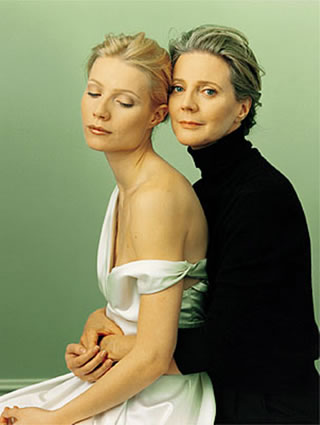
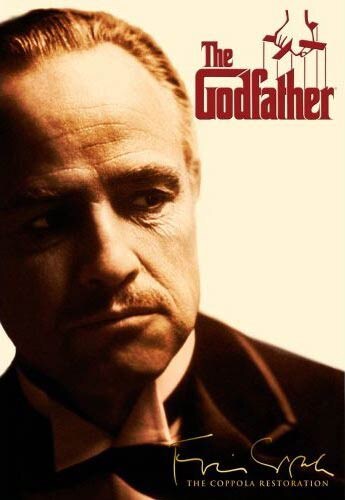
It's also nice to know that people in the industry are perceptive and aware of the ebbs and flows of the industry that employs them, as Gwyneth Paltrow illustrates via her new startup, GOOP. (Must say, I like the place she's set up in her corner of the vast web, her writing is pleasingly minimalistic and informative.) Being a top-billed actress at the height of her powers (that's debateable, but I think she's become so much more meticulous about her career and how she's projected than she was just years ago), one wouldn't think she'd have the time or desire to form and position her opinion on the history of film and its highlights, but not only does she do that, she's also managed to get five directors (only one of whom she's not worked with... yet) to spill their thoughts on what they think are endlessly watchable films. Some more famous than others, they all at least are still in operation and still creating exciting art. Steven Spielberg, Wes Anderson, James Gray, Sofia Coppola, and Jon Favreau. Some surprising picks by each of them, too. "Tootsie" was chosen twice, as was "The Godfather." The latter appears in the Sight & Sound poll as well.

Read her preface, her own favorites, the list and the reasons behind some of the picks at her place. And don't forget to discuss them in the comments.

What did you think of their picks?


IMAGE from: Chic in Paris
IMAGE from: Overstock.com
SCOOPED first by: Slashflm

3/12/09

Lex Luthor Needs a Bailout

Being the comics/superhero nerd (no, comics and superheroes aren't always interchangeable!) that I am, this really tickled me. Jon Hamm (of AMC's phenomenal "Mad Men") would make a compelling and very inspired Lex Luthor, although I have no qualms with Kevin Spacey playing the role. Dashing good looks, deceptively intelligent, certainly articulate - it's the perfect combination for evil. Why has no previous iteration of Luthor played on the looks? He's always bald, yes, but mostly black only sometimes white, and always forgettably bland-looking with no exeggerated physicality like his nemesis. Shouldn't the evildoer be appealing, and attractiveness is always persuasive, or else how can he be so conniving, so convincing time and again? Luthor is a contemporary manifestation of Satan. (Luthor. Lucifer. Hm.) The great deceiver, the great manipulator. Money and wealth are no longer enough of a draw, except in today's market it is, so why not play to other possible traits?


Used the current economic crisis as a backdrop, but was kind of expecting more references. Maybe: "Evil AIG Execs Wreaking Havoc on Wall St. and Main St., Chaos Ensues"? "Rupert Murdoch Slashes Jobs, Kills off Daily Planet"? "Mortgage Crisis Puts Local Resident Clark Kent on the Streets"? "Octo-Mom's Babies are Mutants! More On the Way"? None of these could've been at the hands of Luthor?


And, no, there's still nothing on a new installment in the franchise.

It wasn't intended that while updates on "Iron Man 2" have come out, I posted the Funny or Die video instead, even though the video means absolutely nothing for the next film. Call me a DC fanatic, I suppose. (Truth be told, I'm supremely excited about Mickey Rourke's official involvement in the sequel, playing an evil Russian which is a composite character, and hope some exciting things come out of the development cycle for us to read about and pore over. I'm disappointed about Scarlett Johansson, though, if only because Emily Blunt would've made a killer Black Widow. When you're hot, you're hot, and Blunt still has some people to please before she becomes the star that she deserves to be.)

Should Warner Bros. pursue another round of Superman Saves the Day?


VIDEO from: Funny or Die
SCOOPED first by: Hollywood Elsewhere

3/11/09

Sam Raimi Dragging Alison Lohman to Hell

There's some freaky imagery for you. The indomitable director of the great "Evil Dead" series, "Army of Darkness," and the "Spider-Man" trilogy clenching onto you, maybe by the ankles, as he saunters his way down the corridors of the underworld to Hell, probably with an odd, rattled gait as you bury your nails into decaying rock and soil to keep from going any further, screaming all the way down. For the purpose of this bit of news, we'll call it his return to form, and not some perverse plan of revenge after the lukewarm reception his "Spider-Man 3" received.

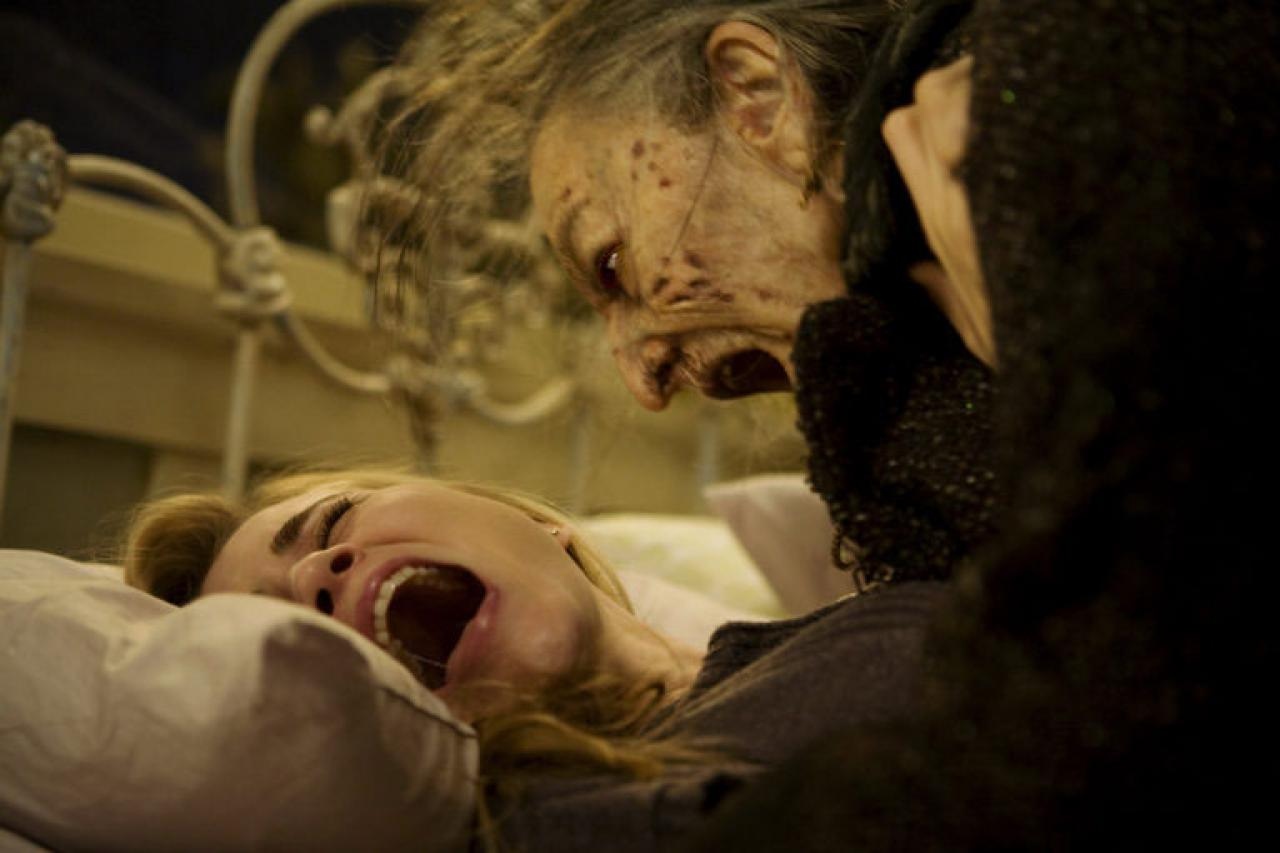
But in all seriousness, this looks fabulous as a comeback even despite its PG-13 rating. Even though the look is cleaner now than his past forays in the genre, it looks and paces like his greatest hits, with absurd camera movements (that were always effective) and lightning-speed flashy cuts of ugly people and demonic figures, and totally predictable "cheap" scares. The gypsy woman looks both hideous and laughable at the same time, and of course Alison Lohman plays into the whole thing in absolute seriousness which makes it an even more intense, involved experience. Raimi's films are undeniable and age better than most of his class (except for maybe Tobe Hooper and vintage John Carpenter and Wes Craven) because even when the effects are horrid or grotesquely exaggerated - as they seem to be here - the actors are body and mind commited to the effect. And, with few exceptions, they work because of that. Pure cinematic experiences in horror, his style has practically become a brand.

The trailer has debuted online via Yahoo! but is embedded below.
The film is also set to debut at SXSW (South by Southwest) next week in Austin, Texas, with some early reviews by fans and critics being positive if not ecstatic. It arrives in theaters on May 29th.


Ready to take the plunge into "Hell"?


IMAGE from: Slashfilm

3/9/09

"Twilight" Sequel Needs a Woman's Touch?

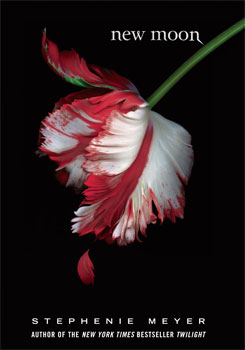
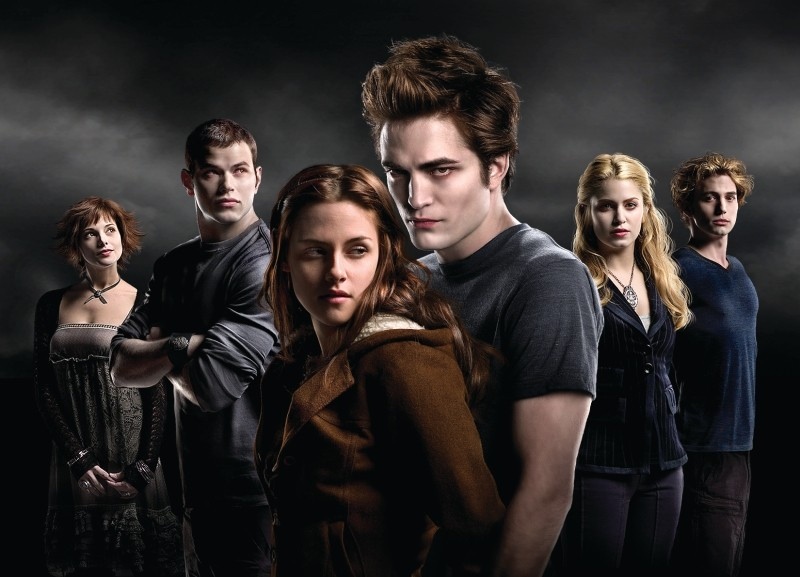
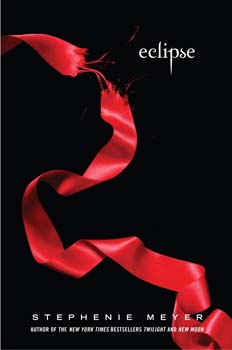
It's now old news that director Catherine Hardwicke isn't returning to the enormously successful "Twilight" franchise, whose success may either be in spite of her involvement or largely because of it, because of bad relations with Summit Entertainment and because of mounting pressures to churn out an adequate sequel by its projected release in November of this year. It's also old news that Chris Weitz ("The Golden Compass") has signed on for "New Moon." But even with all this old news, "Eclipse," the third of four books in the Stephanie Meyer-penned vampire-romance saga whose production schedule should be coming underway soon, still hasn't seen much new news though it's been the subject of much talk lately. (That is, aside from Summit's long-awaited revelation that Dakota Fanning will indeed be in the flick playing Jane with her introduction coming in "New Moon" this fall.) Considering Summit's decision for Weitz to direct this new installment, one begins to wonder if the gender-issue was at play.

I'm of the impression that Hardwicke's contributions to the first film have been propped against her because of how the final product turned out (stilted, messy, inauthentic) which diminishes her own efforts to stay faithful to the novel and balance out some of the characterizations and details in the narrative, as well as to honor the goo-goo ga-ga sexless romance (no doubt for the core audience of tween girls) and the vampire-on-vampire battle scenes and larger set pieces (for their fathers). We've seen before with "Thirteen" and "Lords of Dogtown" that Hardwicke is more than capable of capturing the teenage experience and range of emotions with bravura, so obviously fault can't lie totally with her. As Zack Snyder of "Watchmen" can probably testify after this weekend, adapting a work of literature - and it could be said that Alan Moore's "Watchmen" is leagues more literary than the entirety of the "Twilight" series - is hard. It was likely Summit's high hopes for the film to do well and please both hardcore fans while attracting new ones, and the hopes to produce the remainder of the franchise and compete with Warner Bros.'s "Harry Potter" that doomed Hardwicke's participation, as the environment Summit set up for the filming of the flick seemed always to be tense and angsty, as Nikki Finke reported when news about Hardwicke and Summit's breakup broke. Sounds an awful lot like the life of an adolescent.

This brings us back to the original question: Who is suitable, and available, to direct the remaining sequels? "New Moon" poses a few obstacles for Weitz that were established in the first film, namely, that the entire middle portion of the book features nothing of Edward or his suspense-riddled dilemma with Bella, and a huge amount of the film's following is latched onto the otherworldly handsomeness of Robert Pattinson, as well as to the chemistry between him and co-star Kristen Stewart. Instead, Bella is to have a stint with Jacob (who is no longer being recast but now offers new questions of whether Taylor Lautner will work as an older werewolf) for much of the plot, only to see Edward return at the end. Quite a snag, it is. With the exception of James Bond, few franchises which place romance in the foreground of the narrative have been passed between directors, and even more infrequently between directors of the opposite sex. Romance is hard to draw out not only for the actors who must feign attraction (or not, as has been seen often) but also for the director who must imbue the relationship with enough urgency, usually with the aid of impending tragedy, and intensity so as to not offer even the slightest chance for audiences to accuse inauthenticity or cheesiness. So I offer my own question to add to the mix: Would a woman's hand and vision be needed to bring this love triangle to certain successful fruition?

Not that only women have produced the best cinematic projections of love or are the only ones capable of extrapolating nuance and severity from romance, but if a woman were attached, Summit and its marketers would be more likely to accommodate forays into the amorous affairs between Bella and her gentleman callers more thoroughly rather than pursue the male counterpart with expenses going to special effects (werewolves, remember?) and action sequences. It remains to be seen what Weitz can conjure up in "New Moon," but press around the film already seems to have the notably-heightened action in greater visibility than the romance. The material also yearns for a woman's touch with so few female directors out there, and is one of the few very marketable, very lucrative franchises that could propel women as worthy targets for studios ("Sex and the City," "Devil Wears Prada" and "Mamma Mia!" were all major hits targeted primarily at women). With women as the core, a woman at the helm seems a given.

Drew Barrymore (yes, that one) has been rumored to be in the running for "Eclipse," denied by some sources, but the rumor is rather persistent (even appeared on local news this afternoon) and is definitely gaining some traction out in the blogosphere as a news item. The same source, Kellan Lutz, notes that the director Summit is currently courting, as with on "New Moon," is male yet again (though the name escapes him), and offers his take on the capabilities of directors based on gender: "I don’t think there’s any difference between male or female directors, as far as who can relate." We've definitely seen failures of women to make female-oriented or -friendly films ("Deep Impact") and great films about women directed by men (anything by Pedro Almodovar), but does Lutz really have a point? Is there no difference in the sensibilities of men and women directors?

Whose name would you offer Summit for the third film in the series?

UPDATE (3-12-09): Variety reports that the director for "Eclipse" will be Guillermo del Toro protege Juan Antonio Bayona of the superb "The Orphanage" marking his first English-language film. Not what I would've guessed to be his next project, but it'll certainly be interesting to see what he does. He's already got the macabre elements down. And, whoops, did you see my credibility go out the door on that one? All this talk about how audience and filmmaker should, for once, align for the sake of giving female directors a stronger voice and presence in Hollywood (it's 2009 and how many can we name off the tops of our heads?) and Summit goes the opposite direction. I just hope Catherine Hardwicke lands on her feet and gets back to some great dramas.


IMAGES from: Stephanie Meyer
IMAGE from: Huffington Post

3/6/09

Going "Up"

Kids are attracted to bright colors, balloons, adventure stories, animals (especially if they can talk), and the romance of flight and freedom. It's already been proven that they like cognizant toys, inventive insects, romantic robots, neurotic fish, epicurean rats, and enterprising automobiles. But maybe I'm being presumptuous. Would it be too presumptuous to say that, aside from our own elderly relatives and the sweet, old folks down the street, most of us adults tend not to like old people, or become stricken with anxiety at the thought of having to deal with them? We haters of slow drivers, coupon wielders, and the hearing deprived. If there's one thing I hope Pixar's new flick, "Up," can achieve in its theatrical run, and one thing that I'm sure they'll be more than able to considering their track record, it's popularizing the elderly. I'm of the many who freeze up when addressed by any individual over 60, and I already adore Carl Fredricksen and am completely smitten with the premise, not to mention colors, of this geriatric adventure movie. Call it another notch in Pixar's bedpost, a testament to their sublime ability to balance their characters and temper their comedic reaches.

But of course a talking dog doesn't hurt its case, either. Neither does the inclusion of some very arresting visuals and thrilling-looking chase sequences. Yahoo!'s unveiled the new trailer to swoon children and adults everywhere. And don't forget the old folks, too.


I've read some rather dull plot synopses out there for this film, a bad bedfellow to have when your movie is as risky as this one is (children's flick oriented around a ...grumpy old man!?) and found I rather like the one at Pixar's own promotional site, which is short and very sweet, and adds a nice tinge of sympathetic regret to this movie's emotional repertoire:

Carl Fredricksen is 78 years old. When Carl was a child, he met and eventually married a girl named Ellie who grew up in a small midwestern town. Ellie always dreamed of exploring the mountains, but she died before she got a chance. Now, when developers threaten to move him into an assisted living home, Carl decides to fulfill his promise to Ellie. To accomplish this, he uses a huge number of balloons to make the house fly - but unwittingly takes a chubby eight-year-old Wilderness Explorer named Russell with him. The two opposites match up for thrilling adventures as they encounter wild terrain, unexpected foes, and all the terrifying creatures that wait in the jungle.
With folks still in the process of convalescing from "WALL*E" fever after it hit us so hard last season, could this be yet another example of the neglected elderly, slumped in the corners of the neighborhood cineplex, repeating "I've fallen and can't get up"?

Will you be going "Up" on May 29th?


IMAGE from: Wikipedia
SCOOPED first by: Ain't It Cool

3/4/09

Time for a Bale-out

...and I don't mean the kind Bale's already had. That'd be more like a meltdown (and "fucking distracting"). I'm also not talking about a stimulus package or Congressional assistance out of bankruptcy, though perhaps the timing would be good for either of those. No, I'm simply referring to the fact that, in the span of a week, two trailers have debuted that feature Christian Bale rather prominently. And they come packaged with some new posters, too. He's here to save our flailing economy, he is. Color me excited, I relish any opportunity to see new work by him (my favorite actor, after all).

The first to appear online is the fourth installment in the Terminator saga, titled "Terminator: Salvation" with McG ("Charlie's Angels") at the helm (instead of creator James Cameron) and with Bale in the now-adult shoes of the John Connor character which was first played by Edward Furlong in "T2: Judgment Day" and then by Nick Stahl in "T3: Rise of the Machines." Yahoo! Movies has the trailer, which was a huge hit at WonderCon, and this one lays out a bit more than the first trailer did - with some more glimpses into the resistance with shots of Common looking fierce with a rifle as John's right-hand man Barnes, Anton Yelchin as the youthful Kyle Reese (John Connor's father) who was the main character in the first "Terminator," and Bryce Dallas Howard as Kate Connor which was vacated by Claire Danes after her stint in the third movie. It also accentuates the dilemma John Connor faces with Sam Worthington's Marcus Wright, who they discover possesses robotic parts and could be a terminator in Skynet's efforts to produce human-like droids which ultimately produced the likes of Arnold Schwarzenegger throughout the original trilogy as well as Robert Patrick in "T2" and Kristanna Loken in "T3." McG kept hinting at the likelihood of Ah-nuld and Linda Hamilton (John Connor's mother, Sarah) making cameo appearances, and I'm holding out hope that it's true. The movie looks intense and very reverent of the mythology created by James Cameron, but if they can get some of the original faces in there (even in voice-form) then that'd be even better. It debuts May 21.

Anne Thompson thinks this one has far better chances at winning audiences than "Watchmen," which is similar to "T4: Salvation" in the way that both are contemporary translations of established lore and imagery, which has been seeing some rather nasty reviews come pouring in, with some rather ecstatic ones sprinkled in as well. (Here's Anthony Lane's acidic yet entertaining pan and Roger Ebert's high praise.) Thus: "As much as my instincts tell me that Watchmen will be a cult hit but a box office disappointment for Warner Bros, this Terminator Salvation trailer tells me that this action sequel is just what the doctor ordered."

Number two is Michael Mann's "Public Enemies" which stars both Johnny Depp and Bale with a rather impressive supporting cast which consists of Oscar-winner Marion Cotillard ("La Vie en Rose" and the upcoming "Nine"), Billy Crudup, Giovanni Ribisi, and Channing Tatum. Crudup has been pulling in some great early word with more than a few mentioning Oscar. We'll see how that pans out.

The premise of the film is the real-life story of gangster John Dillinger (Depp) in an episode of his life where, due to his multi-state crime spree during the 1930s which would've made Bonnie and Clyde go into retirement sooner, the US government had no other option but to create the FBI - whose top agent, Melvin Purvis (Christian Bale) - was the one assigned to finally track down Dillinger and bring him to justice. Sounds rather basic for a gangster flick (by now), but there are some peculiar twists involved, the state of Indiana providing one of them (to some humor as delivered by Depp, no less) and Marion Cotillard another. Like "Bonnie & Clyde," this seems to have some sardonic humor sewn in (also channels its imagery and cinematography if the poster and trailer are any indication). I fully expect some more flourishes and knots in the narrative, as this is a Michael Mann film after all. The man's built his career studying bad people getting into worse situations at the hands of the law, and career killers and manipulators coming up against hard times because of a lack of restraint (usually at the foot of a beautiful woman or the prospect of a load of money). (Notable Mann flicks - err, man-flicks - are "Heat," "The Insider," "Ali," and "Collateral.") His characters are modern-day Greek figures at the mercy of the inevitable self-inflicted catharsis - only this time it's based on real cops and robbers. You can find the trailer at Apple Trailers (Quicktime) or at JoBlo (flash). Expect it in the late summer, my guesses.

As much a fan as I am of Christian Bale's, I'm not as thoroughly excited about either of these as I have been with his past works, notably his collaborations with Chris Nolan but especially "The Prestige," as well as "The Machinist," and "3:10 to Yuma." While "Public Enemies" does have potential to be a roiling, devilish crime drama with some great dialogue and opportunities galore for Bale to do what he does best - shout and brood (reaffirmed by his meltdown) - it's the action that's the centerpiece here. Hard to fit that in with some "American Psycho"-style monologues and outbursts, which is a shame since that performance was easily the best of 1999 for me and I think he's far overdue for another character of that level in playfulness, bravado and subversion.

Which one are you more excited to see?


IMAGE from: Buzz Focus
IMAGE from: Cinematical

3/2/09

Rubenesque Comedians

It's nice that Annie Leibovitz can poke fun at her own work (in this case, it's another Vanity Fair cover shot, this one from 2006 with Tom Ford, Scarlett Johansson and Keira Knightley - Rachel McAdams was set to feature as well but dropped out after the clothes dropped off) despite being one of the foremost celebrity photographers in modern publication, and she's doing it with some good company. From left to right: Paul Rudd, Jonah Hill, Seth Rogen and Jason Segel. Also known as: the new Dirty Pretty Things. (Does it seem strange, though, that she's referenced herself twice in this one shoot? But at least they're not redoing the whole "mock-celebs-who-act-badly" premise.) This time, it's essentially the school of Judd Apatow where the previous shoot was oriented around comediennes de SNL and their ilk. Also featured in the new issue: Danny McBride from "Pineapple Express," Russell Brand from "Forgetting Sarah Marshall," and Apatow's own wife Leslie Mann who will play Adam Sandler's love interest in the upcoming "Funny People." Some funny people, alright, love the nude suits.


IMAGE from: Hollywood Elsewhere

3/1/09

Give Her A Movie

A few weeks ago, Elisabeth Rappe at Cinematical chalked up a rather intriguing question that studio execs are always asking themselves to prepare for the year's Oscar bait season: Who's in need of a biopic? They're a favorite of Hollywood, because they adapt the lives of mostly famous people into often conventionalized yet fascinating portraits that're ripe with drama, triumph, humor, tragedy and social commentary - a perfect mixture to appeal to Academy members. They also run opposite of ensemble flicks, of course, by highlighting the notoriety or stardom of a single person; and it's no wonder you'll find more nominated performances from a biopic than an ensemble piece because more depth and imitation is found in these than can fit in a film populated by a small soccer team of six or seven. The popularity and success scale of biopics resembles a bell curve, with those biopics which explore very famous people tending to hit the mark and make it to Oscar with at least an acting nomination of some sort ("Ray," "Ali," "Walk the Line," "The Queen") while also laying favor to the most obscure people - those who might be notable or important to their field or circle, but who lack the elements which we require to be called famous ("La Vie en Rose" about French singer Edith Piaf, "Milk" which explored well-known but not famous local politician Harvey Milk, "The Last King of Scotland"'s Idi Amin or "Hotel Rwanda"'s Paul Rusesabagina).

Rappe's own suggestions of Lev Trotsky and Mary Wollstonecraft (definitely the latter in the above, which is a pity on both accounts) come at the heels of the announcements that action star Steve McQueen and literary giant Ernest Hemingway will both be getting their dues finally in cinematic form (have neither been explored before? comment below!). For the purpose of this game we're playing, since I am asking for your thoughts on who you think is deserving of a biopic, let's see how obscure we can get with our choices. Or, even better, the most famous people yet to have a biopic - there's real blasphemy being committed out there with some of the glaring omissions that are coming to the fore with these new announcements (like Steven Spielberg's long and hard attempts at getting his Lincoln picture made, which might be getting yet another push - ack!).

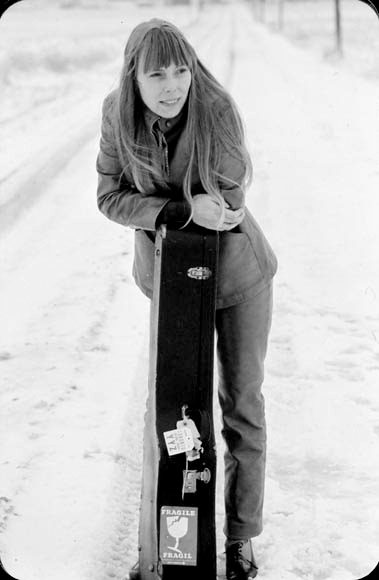
Some of these biopics are getting really strange ("W.," for instance), but a lot of creativity has been fuelling some of the latest projects and the biopics of the last few years. Which brings me to my personal choice. We've had films which used extensive amounts of Bob Dylan's music, then we've got "I'm Not There" which may be the most inspired and most unique angle for a biopic yet (though the Diane Arbus pic, "Fur," was also quite odd and captivating). Why not devote an entire film to music's other great, female singer-songwriter - Joni Mitchell? She's a magnificent musician and hugely influential, as influential as Dylan I'd contend, and her life has been quite amazing with her frequenting the likes of Dylan, Janis Joplin, Carole King, and Herbie Hancock over the course of her long career, and straddling cultural moments like the beatnik movement, Woodstock (which she didn't actually attend), folk going electric, the rise of MTV and the Rock and Roll Hall of Fame. The movie could cast two different leads to play the younger, more delicate and higher-pitched Mitchell and the older Mitchell with her drops in octaves and resurgence as a more politically-charged artist.

Who fits the bill for a biopic?

IMAGE from: More Things
IMAGE from: The Cinematic Art